
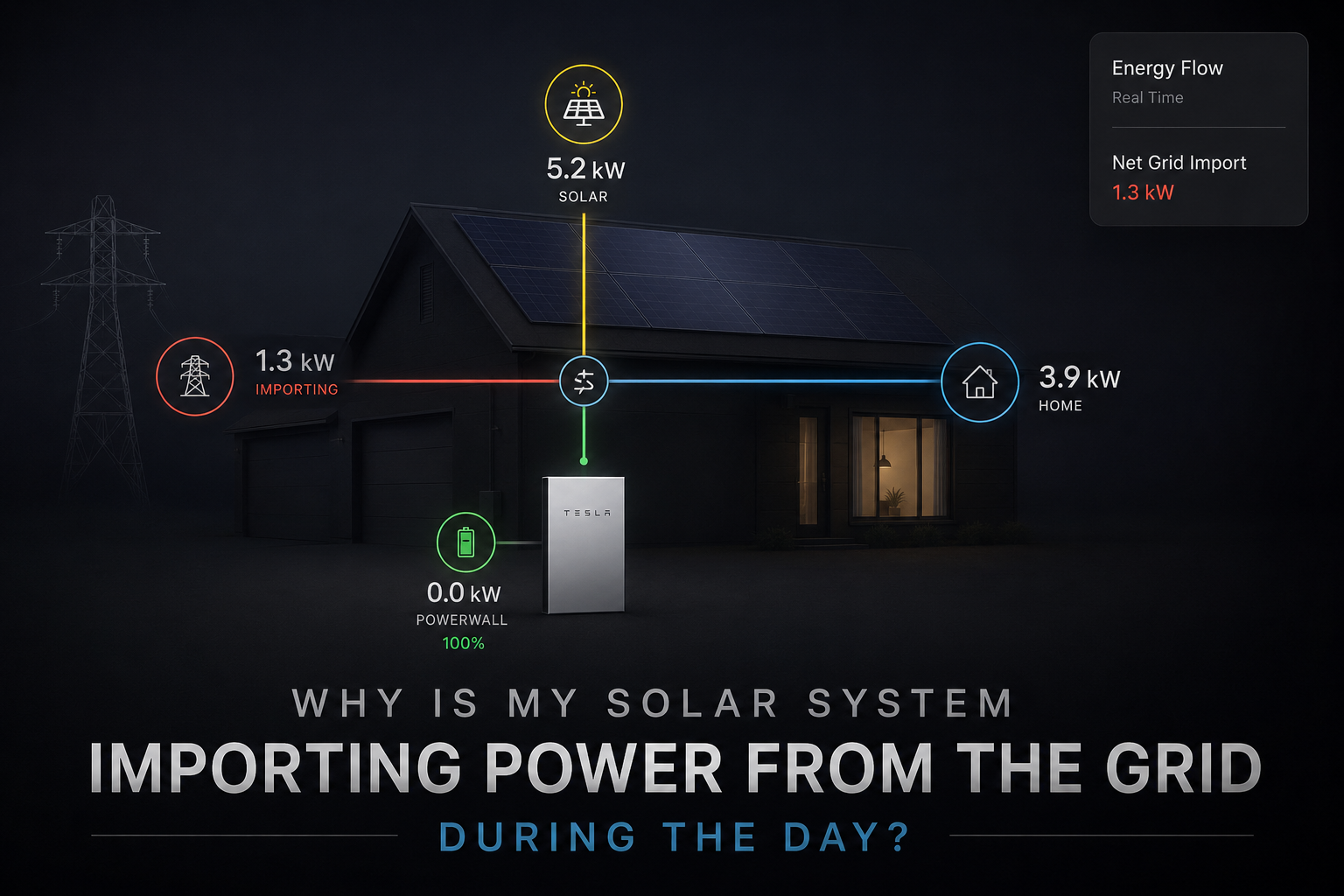
Seeing your solar monitoring app show power coming from the grid in the middle of a sunny day can look like something is wrong.
Sometimes it is. Often, however, the system is simply producing less power than the home is using at that moment.
A grid-connected solar system does not normally choose between solar power and utility power. Both sources work together automatically. Solar supplies as much of the household demand as it can, and the grid supplies the difference.
How Solar Production and Grid Import Work Together
Suppose your solar system is producing 4 kilowatts, but the house is consuming 6 kilowatts. The home will use the full 4 kilowatts of solar production and import the remaining 2 kilowatts from the grid.
The system is still saving you money. It just is not producing enough to cover the entire load at that particular moment.
If solar production increases to 7 kilowatts while the home continues using 6 kilowatts, the house will stop importing and begin exporting approximately 1 kilowatt to the grid.
PG&E explains this same basic relationship in its guide to SmartMeter energy flow for solar customers.
Common Reasons a Solar System Imports Power During the Day
Your Home Is Using More Power Than the Solar System Is Producing
This is the most common explanation.
Large electrical loads can quickly exceed the output of a residential solar system, even around midday. Common examples include:
- Central air conditioning
- Electric vehicle charging
- Pool or well pumps
- Electric water heaters
- Electric ovens and ranges
- Clothes dryers
- Heat pumps
- Multiple appliances running at once
A 7-kilowatt solar system does not produce 7 kilowatts all day. That rating represents its approximate DC nameplate capacity under standardized test conditions. Actual output changes continuously with sunlight, temperature, panel orientation and other conditions.
The Solar System Has Not Reached Peak Production
Solar production follows a curve rather than switching instantly to full output when the sun comes up.
The system may import power during the morning, gradually reduce that import as production rises, export around midday and then begin importing again later in the afternoon.
East- or west-facing arrays may also produce noticeably different curves than south-facing systems. A west-facing system generally reaches its strongest output later in the day, while an east-facing system favors the morning.
Clouds, Smoke or Haze Are Reducing Production
Solar output can drop quickly when clouds pass over the array. The house may briefly import power, return to exporting and then import again several times during the same hour.
This is especially noticeable when air conditioning or another large load is already running.
Smoke and persistent haze can also reduce production across the Sacramento region, even when the sky does not appear completely overcast.
High Panel Temperatures Are Lowering Output
Solar panels need sunlight, but they do not necessarily perform better as they get hotter.
On a summer afternoon in Sacramento, panel temperatures can rise well above the outdoor air temperature. As panel temperature increases, electrical output generally decreases.
A system may therefore produce less on an extremely hot afternoon than it does under cooler, clear conditions with similar sunlight.
Your Battery Is Charging
On a solar-and-battery system, some of the available solar power may be directed into the battery instead of being sent to household loads or exported.
Battery behavior depends on the equipment, operating mode, reserve setting, utility rate plan and time-based control settings.
For example, a system may charge the battery aggressively during the day so that stored energy is available during the more expensive evening period. Depending on the system configuration, the home may briefly import from the grid while solar production is being divided between household loads and battery charging.
The Battery Is Preserving Its Backup Reserve
A battery does not always discharge just because the home is importing power.
If the backup reserve is set to 50%, the system may avoid using the remaining stored energy once the battery reaches that level. The house will then import from the grid even though the battery is not completely empty.
This can be normal operation rather than a battery failure.
The Inverter Is Limiting or Interrupting Production
Grid voltage, inverter temperature, equipment faults and system configuration can all affect inverter output.
Some problems cause a complete shutdown. Others cause the inverter to reduce production or repeatedly disconnect and reconnect throughout the day.
A system experiencing utility-voltage issues may look normal much of the time while losing production during the strongest solar hours.
Part of the Solar Array Is Not Producing
A solar system can remain online even when one or more components have failed.
Possible causes include:
- A failed microinverter
- A failed power optimizer
- A disconnected module
- A damaged DC connector
- A failed string
- A tripped breaker or open fuse
- An inverter input that is not operating
The monitoring platform may still show current solar production, but total output can be lower than it should be.
This is one reason a green status indicator does not always prove that every panel or component is working.
Shading or Soiling Has Reduced Available Solar Power
New tree growth, leaves, debris, bird activity and accumulated dirt can reduce production.
Not every dirty panel needs professional cleaning, and light dust alone usually does not explain a dramatic production loss. Heavy localized soiling or new shade, however, can have a more meaningful effect.
The impact depends heavily on the inverter architecture, array layout and which modules are affected.
The Monitoring Data Is Incorrect
Sometimes the solar system is operating correctly but the power-flow display is wrong.
Consumption monitoring usually relies on current transformers, commonly called CTs. If those sensors are installed backward, placed on the wrong conductors, assigned to the wrong phase or configured incorrectly, the monitoring platform may display false import, export or consumption values.
A phasing mismatch can produce especially confusing results. The app may show grid import while the utility meter shows export, or household consumption may rise and fall with solar production in a way that does not make sense.
In that situation, the problem is not necessarily solar production. It may be the measurement system.
Does Daytime Grid Import Mean the Solar System Is Too Small?
Not automatically.
Nearly every grid-connected solar home will import power at certain times. The more useful question is whether the amount and timing of that import are reasonable for the system size and household load.
An occasional import while the air conditioner and electric dryer are running is not particularly concerning. Consistent grid import during clear midday conditions, while household demand is modest, deserves a closer look.
The system may be undersized, but it could also be underproducing because of failed equipment, shading, inverter limitations or incorrect monitoring.
How to Tell Whether the Grid Import Is Normal
Start by comparing the following information at the same time of day:
- Current solar production
- Current household consumption
- Current battery charge or discharge power
- Grid import or export
- Operating status of individual modules or optimizers, when available
The power values should generally balance.
For example, if the home is using 5 kilowatts and the solar system is producing 3 kilowatts, approximately 2 kilowatts must come from either the battery or the grid.
Next, compare current production with previous clear days at a similar time. A major unexplained reduction may indicate a production problem.
Check the Utility Meter, Not Just the Solar App
The utility meter provides an independent reference for whether the property is currently importing or exporting power.
Your solar monitoring platform and utility meter may not show identical numbers because they update at different intervals and measure energy in different locations. However, they should generally agree on the direction of power flow.
If the app shows substantial grid import while the utility meter clearly shows export, the consumption-monitoring configuration may be incorrect.
Keep in mind that the utility meter measures only the net electricity crossing between the property and the grid. It does not directly measure all solar production or total household consumption.
When Daytime Grid Import May Indicate a Problem
Further investigation may be appropriate when:
- The system imports continuously through clear midday hours
- Solar production is much lower than it was during similar conditions
- One or more panels, optimizers or microinverters are missing from monitoring
- The inverter reports faults, shutdowns or repeated grid events
- The monitoring app and utility meter disagree about power-flow direction
- Grid import increased suddenly without a change in household usage
- The electric bill has increased despite apparently normal monitoring
A proper diagnosis should compare system production, household consumption, battery behavior, monitoring accuracy and utility data rather than relying on a single screenshot.
Learn more about solar performance optimization and utility-bill analysis in the Sacramento area.
The Bottom Line
A solar system importing power from the grid during the day is not automatically malfunctioning.
Most often, the home is simply using more electricity than the solar system is producing at that moment. Weather, panel temperature, battery charging and large household loads can all cause normal daytime import.
However, persistent import during strong sunlight can also point to underproduction, failed equipment or inaccurate consumption monitoring.
The important step is to determine whether the numbers make sense together. Solar production, household consumption, battery power and grid flow should tell one consistent story. When they do not, the system needs a closer look.
Leave a Reply