
A solar app can show production, home consumption, and battery activity without those numbers being correct. The equipment may be online and producing power while a metering error quietly distorts the picture.
CT issues are a documented installation and troubleshooting concern in residential solar and battery systems. But how common are they across all installations? There is no reliable industry-wide percentage I can point to. Understanding how they happen is more useful than putting an unsupported number on them.
What Do Current Transformers Measure?
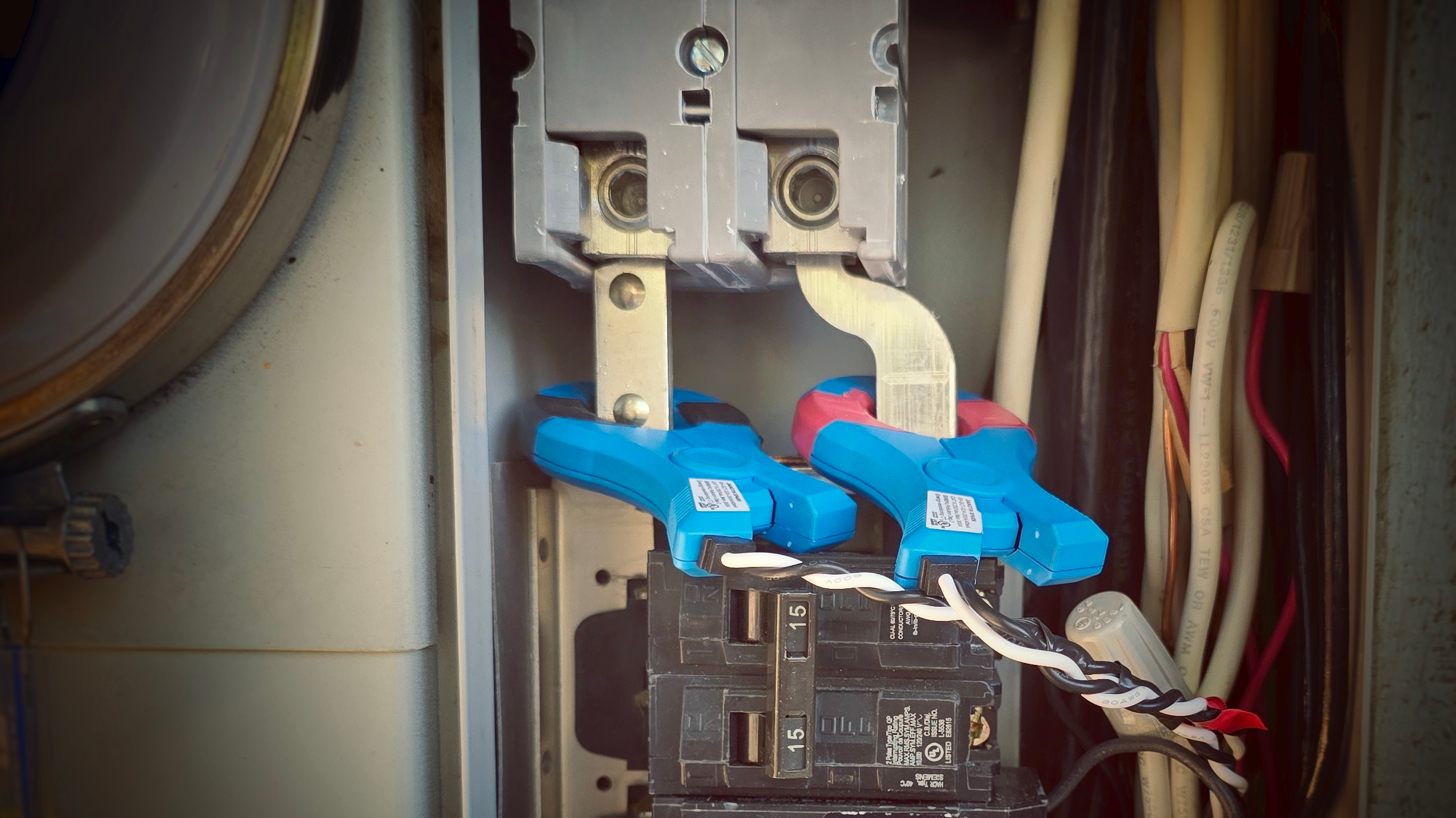
A current transformer, or CT, is a sensor placed around an electrical conductor to measure alternating current. It lets the system monitor current without putting the sensor directly in the circuit’s power path.
The alternating current creates a changing magnetic field, which induces a signal in the CT’s secondary winding. Faraday’s law describes that induction; Lenz’s law describes how the induced response opposes the change that produced it.
The meter combines the CT signal with a voltage measurement to calculate power and determine whether electricity is being imported or exported. The CT alone does not measure watts or establish power-flow direction.
You may remember the basic relationship P = I × E: power equals current times voltage. For AC real power, power factor also matters. With sinusoidal waveforms, P = V × I × power factor. That is why matching each CT to the correct voltage reference is essential.
For more background, see current transformers in residential solar and battery systems.
How CT Readings Affect Home Consumption and Battery Control
In many systems, the home-consumption number is calculated rather than measured by a separate sensor on every household circuit. Site metering measures exchange with the grid, while solar and battery measurements complete the calculation. Some designs measure loads directly instead.
Using positive values for imports, exports, charging, and discharging, the simplified power balance is:
Home consumption = solar production + grid imports + battery discharge − grid exports − battery charging.
For example, 5 kW of solar production with 2 kW exported and an idle battery leaves approximately 3 kW supplying the home. Actual displays can differ slightly because of losses, rounding, and update timing.
If an input is wrong, the calculated consumption can be wrong too. Tesla’s CT installation and verification notes specifically explain that its load reading is calculated from solar, site, and battery measurements.
The system controller uses metering data, operating settings, and battery limits to decide when to charge or discharge. The battery management system protects and monitors the battery itself; it is not necessarily the component calculating household consumption.
Incorrect metering can therefore affect more than the graph. Depending on the equipment and control mode, it can interfere with self-consumption, export control, or battery response to household demand.
How Common Are CT Installation Errors?
Manufacturer guidance confirms that these errors occur. For example, Lion Energy’s Sanctuary CT troubleshooting guide identifies CT installation errors as its most common installation problem.
That statement applies to its equipment and experience. It does not establish a percentage for all Tesla, SolarEdge, Enphase, or other residential systems.
Service-call statistics would also need context. Systems brought in for troubleshooting are more likely to have problems than a random sample of installed systems. A percentage from diagnostic visits should not be presented as the failure rate for every installation.
Why Can Solar CTs Be Difficult to Get Right?
Clamping on a sensor is straightforward. Making sure it measures the right part of the system takes more care.
- Incorrect orientation: A reversed CT can invert the meter’s interpretation of power direction. Follow the specific manufacturer’s markings.
- Incorrect phase matching: A CT on L1 paired with an L2 voltage reference can produce incorrect signed power readings.
- Incorrect placement: A sensor may miss a subpanel or include equipment that should be measured separately.
- Incorrect configuration: The selected meter role, CT ratio, or load-measurement arrangement may not match the wiring.
- Physical or wiring problems: A split-core CT that is not fully closed, a damaged lead, or an improper extension can affect measurements.
Battery retrofits add complexity, especially with multiple panels, existing solar equipment, and partial-home backup. A system can also appear correct under one operating condition while an error becomes obvious under another.
Turning the equipment on and checking that numbers appear is not a complete metering verification.
Symptoms of CT Issues in Solar and Battery Systems
Watch for patterns that do not fit what the house is actually doing:
- Negative household consumption.
- Home consumption that closely mirrors solar production without a matching change in appliance use.
- Reported solar production at night, beyond minor measurement noise.
- A major appliance starting without a corresponding increase in reported home consumption.
- Import and export directions that disagree with the utility meter.
- Battery charging or discharging that seems inconsistent with demand and the selected operating mode.
These are clues, not a diagnosis. Backup reserve, charge schedules, export permissions, temperature limits, and battery power limits can also explain unexpected behavior.
How Can Homeowners Check for Incorrect CT Readings?
Check the App After Sunset
Solar production should be approximately zero. If the battery is idle, home consumption should roughly match grid imports. If it is discharging, the home may be supplied by both the grid and battery.
Observe a Normal Appliance Load
Watch the live display while an appliance, such as a microwave or electric kettle, runs normally. Allow for the app’s update delay. Home consumption should increase, though grid imports may stay steady if the battery supplies the additional power.
Compare Grid Readings With the Utility Meter
If your PG&E or SMUD meter provides an identifiable live import/export display, compare it with the app at approximately the same time. Compare grid exchange with grid exchange, not utility exports with total solar production.
For daily totals, use matching time periods and separate import and export data where available. Small differences can reflect measurement accuracy or timing; large, persistent differences deserve investigation.
Save screenshots with timestamps and note which appliances were running. Homeowner checks should stay outside electrical enclosures. Do not remove panel covers or reposition CTs yourself.
What Should You Do if You Suspect CT Issues?
Ask the installer or a qualified solar and battery technician to verify metering against the actual wiring and independent electrical measurements.
The review should cover orientation, phase matching, sensor placement, connections, and software configuration. Verification should include both service legs and different operating conditions, including changes in household load.
Request before-and-after readings showing that the correction worked. Changing battery settings without validating the measurements can leave the underlying problem unresolved.
For Sacramento-area homeowners, a CT error can complicate an already confusing electric-bill problem. Your utility generally bills from its own meter, so incorrect app readings do not automatically mean the utility bill is wrong. However, poor battery control caused by incorrect metering can change actual grid imports and exports.
Accurate measurements are the starting point for evaluating solar performance and battery operation. If the numbers do not reflect what the home is doing, verify them before deciding the system needs more panels, a larger battery, or replacement equipment.
Leave a Reply