
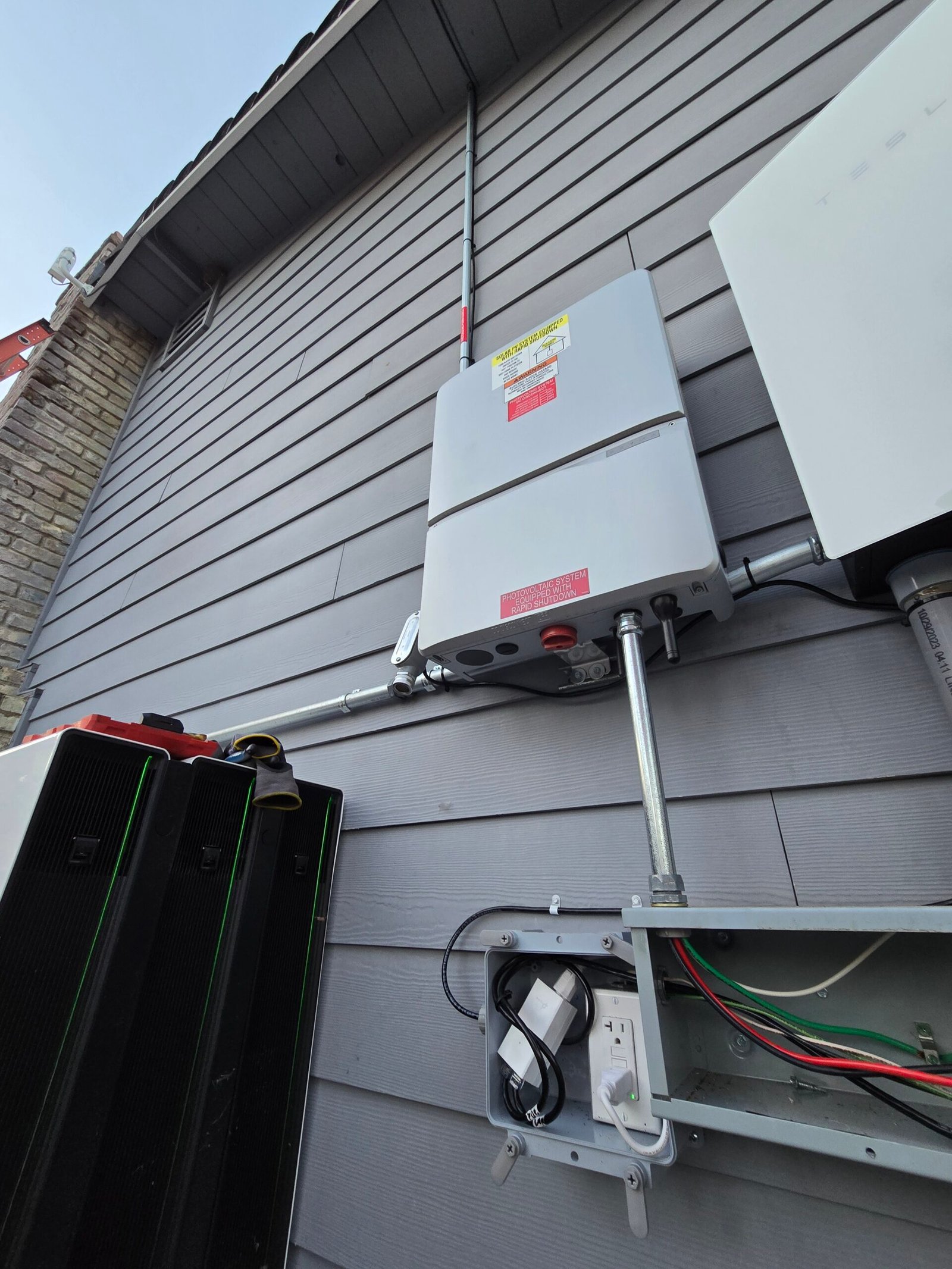
An inverter failure does not necessarily mean an older solar system has reached the end of its useful life.
In many cases, a failed or obsolete inverter can be replaced while the existing solar panels, racking, wiring, and other equipment remain in service. The catch is that replacing an inverter on an older system is not always as simple as finding another unit with the same wattage rating and connecting it.
For homeowners considering solar inverter replacement Sacramento and throughout the surrounding area, the more important question is whether the new inverter is electrically and functionally compatible with the rest of the existing system.
Can You Replace an Old Solar Inverter With a New One?
Yes. Many older solar systems can be successfully fitted with a modern replacement inverter.
This is sometimes referred to as repowering an existing solar system. Instead of removing panels that may still have many years of usable life left, the failed or outdated power electronics are replaced while as much of the original system as practical remains in place.
Inverter manufacturer Fronius, for example, specifically discusses using newer inverters to repower older photovoltaic systems.
Whether this is practical on a particular system depends heavily on how that system was originally designed.
What Determines Whether a New Inverter Is Compatible?
A replacement inverter has to match more than the total wattage of the solar array. Several electrical and equipment characteristics need to be checked first.
1. Solar Array Voltage
Solar panels connected in series form a string, and the voltage of those modules adds together.
The new inverter must be able to safely accept the operating voltage of the existing strings. The maximum open-circuit voltage also has to remain below the inverter’s maximum DC input rating, including the voltage increase that occurs during colder weather.
A system cannot simply be connected to an inverter because both happen to be rated at, for example, 5 kW.
2. MPPT Operating Range
Modern string inverters use Maximum Power Point Tracking, or MPPT, to operate the solar array efficiently.
The voltage produced by each existing string needs to fall within the operating range of the new inverter. An older array with relatively short or unusually configured strings may not be a good match for every modern inverter.
3. String Current
Current matters as well.
Modern solar panels have generally increased in current over the years, and inverter designs have changed along with them. An older array usually produces less current than a new array, but the existing string configuration still needs to be checked against the replacement inverter’s input ratings.
Older SolarEdge Systems Require Special Consideration
Systems using power optimizers are different from conventional string-inverter systems.
SolarEdge inverters communicate with and operate in conjunction with SolarEdge power optimizers installed under the panels. Because these components function as a system, you generally cannot remove a failed SolarEdge inverter and substitute an unrelated conventional string inverter without substantially redesigning the array.
Even when replacing an older SolarEdge inverter with a newer SolarEdge model, optimizer compatibility, string configuration, firmware, commissioning requirements, and monitoring access should be verified first.
This is one reason diagnosing the system before purchasing replacement equipment is important.
What About Older Systems With Standard String Inverters?
Conventional string-inverter systems can sometimes be considerably easier to retrofit.
An older SMA, Fronius, ABB, Delta, or similar inverter may not necessarily have to be replaced with the exact same brand. If the panels and string configuration fall within the electrical requirements of a suitable modern inverter, another manufacturer may sometimes be an option.
This can be especially useful when the original model has been discontinued or the manufacturer no longer supports it.
However, the existing array configuration still needs to be evaluated rather than assuming that a newer inverter is automatically interchangeable.
Microinverter Systems Are Different
If your system uses Enphase or another microinverter architecture, there is no single central solar inverter to replace.
Each panel normally has its own microinverter installed underneath it. A failure may involve one microinverter, several microinverters, a communication gateway, or another component rather than one central inverter.
Compatibility between different generations of microinverters can also vary, so replacing components on an older microinverter system requires its own evaluation.
Battery Systems Can Make Inverter Replacement More Complicated
If the solar system includes battery storage, inverter replacement deserves additional attention.
A battery may communicate directly with a particular inverter, gateway, meter, or energy-management platform. Replacing the solar inverter with a different model can affect battery communication, charging behavior, backup operation, monitoring, or system controls.
Before changing inverter equipment on a solar-plus-storage system, the entire system architecture should be reviewed rather than treating the inverter as an isolated component.
Will Replacing an Inverter Require Other Solar Upgrades?
Sometimes.
A straightforward like-for-like replacement may require relatively few changes. A major change in inverter type or system architecture can be more involved.
Depending on the existing equipment and the requirements of the local authority having jurisdiction, the project may involve reviewing or modifying:
- DC disconnecting equipment
- Rapid-shutdown equipment
- Grounding and bonding
- AC breakers and conductors
- System labeling
- Monitoring equipment
- Utility interconnection requirements
- System commissioning
The exact requirements depend on the original system, the extent of the modification, and the jurisdiction.
Do You Need to Replace the Solar Panels Too?
Usually not simply because the inverter has failed.
Solar panels and inverters have very different operating lives. It is common for an inverter to fail or become obsolete while the modules themselves remain completely serviceable.
If the panels are producing normally and their electrical characteristics are compatible with the replacement equipment, keeping the existing array can often make far more sense than replacing the entire solar system.
Diagnose the System Before Replacing the Inverter
One mistake I see with older solar systems is assuming that a lack of production automatically means the inverter has failed.
Similar symptoms can also be caused by:
- An open or damaged solar string
- A failed power optimizer
- DC isolation or ground faults
- AC voltage problems
- A tripped breaker or failed disconnect
- Communication or monitoring problems
- Incorrect configuration
- Utility-related shutdowns
Installing a new inverter without identifying the original problem can result in an expensive replacement that does not actually fix the system.
That is why my approach to solar inverter repair and replacement in Sacramento starts with diagnostics. The goal is to determine whether the inverter has actually failed, whether replacement is justified, and what equipment will work with the existing array.
Solar Inverter Replacement Sacramento: The Bottom Line
Yes, a new inverter can often be installed on an older solar system.
The solar panels do not need to be the same age or generation as the inverter. What matters is whether the existing array, string configuration, power electronics, monitoring equipment, and any battery equipment are compatible with the replacement.
For a conventional string-inverter system, there may be several replacement options. Optimizer-based and battery-integrated systems can be more restrictive.
Before replacing anything, determine exactly how the existing system is configured and why it stopped working. On an older or orphaned solar system, that evaluation can be the difference between a straightforward inverter replacement and buying equipment that was never going to work with the system in the first place.
Leave a Reply